New clients, and each one’s progress in plain sight.
Your profile appears in Confidey’s search, for free, and contact requests land in your Today. Between sessions, people use Confidey day to day, and you see what they allowed, drawn over time.
Already have an account? Log in
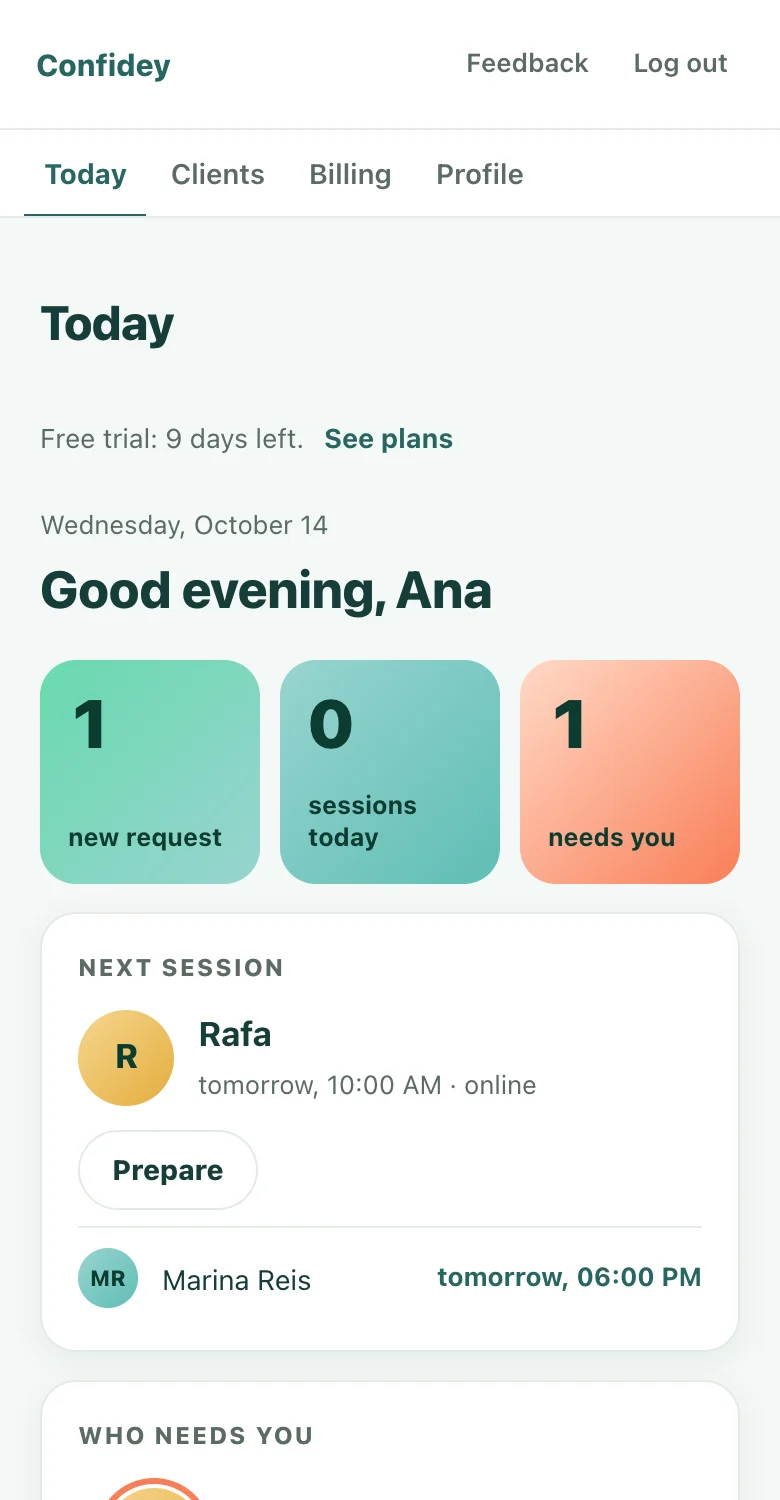
See how it works between one session and the next.
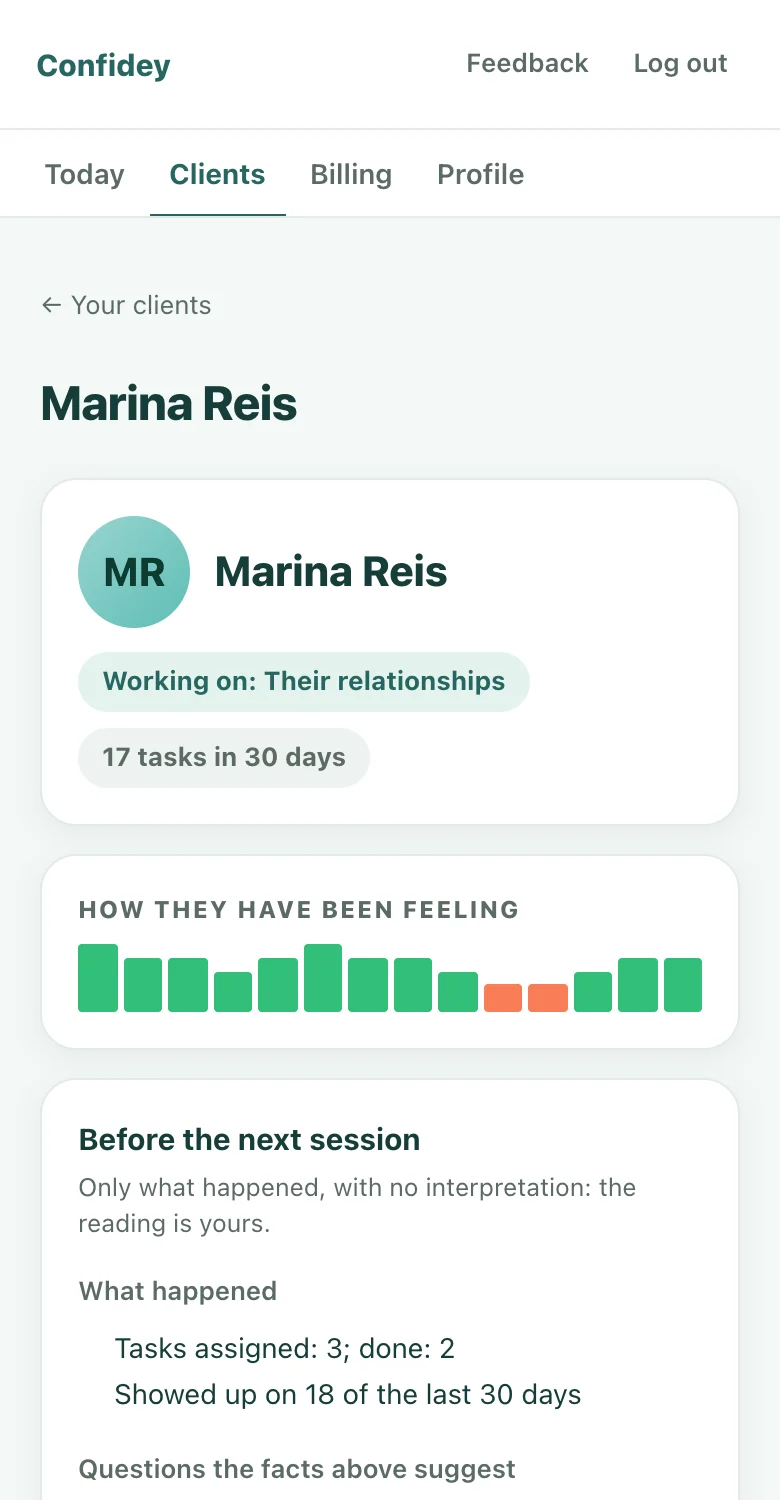
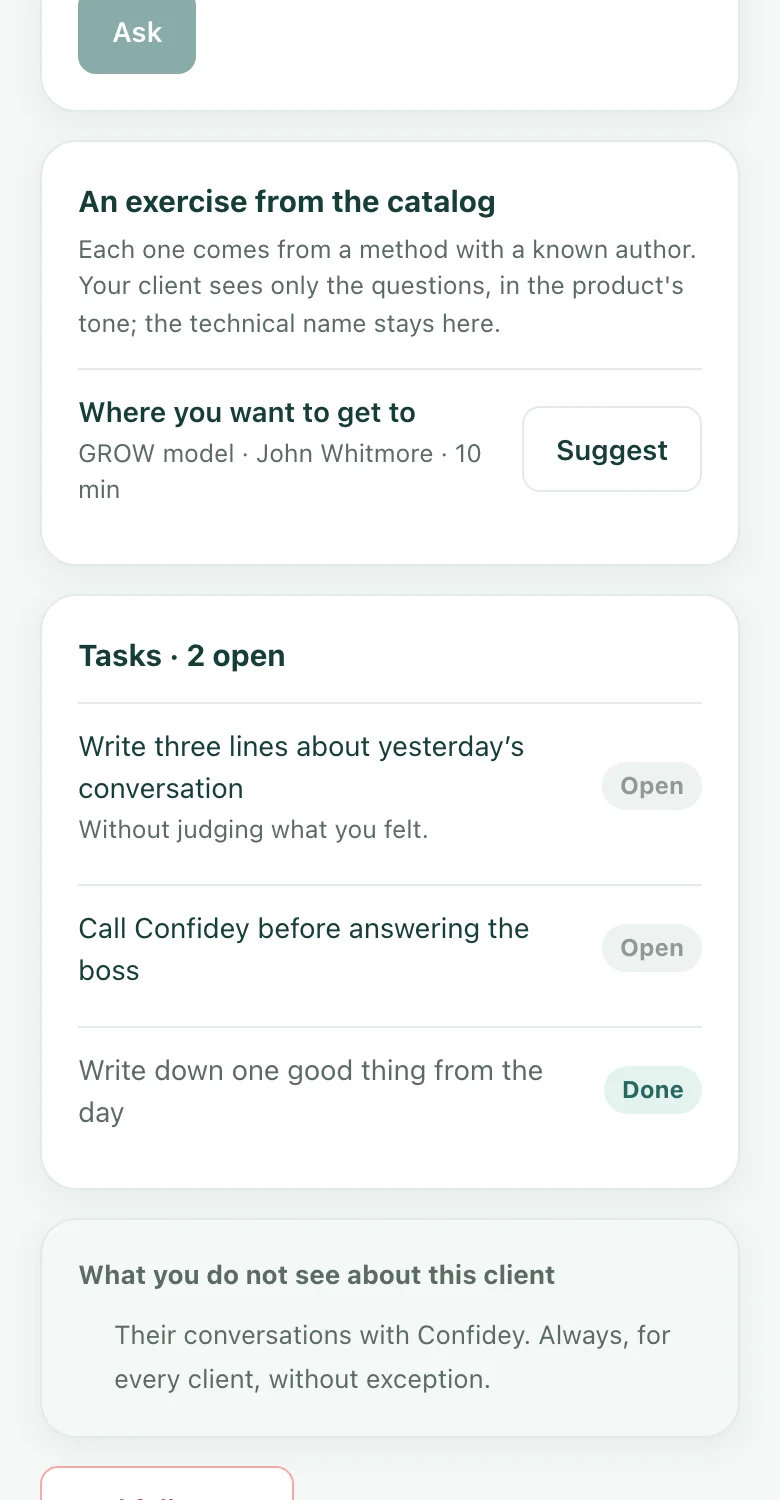
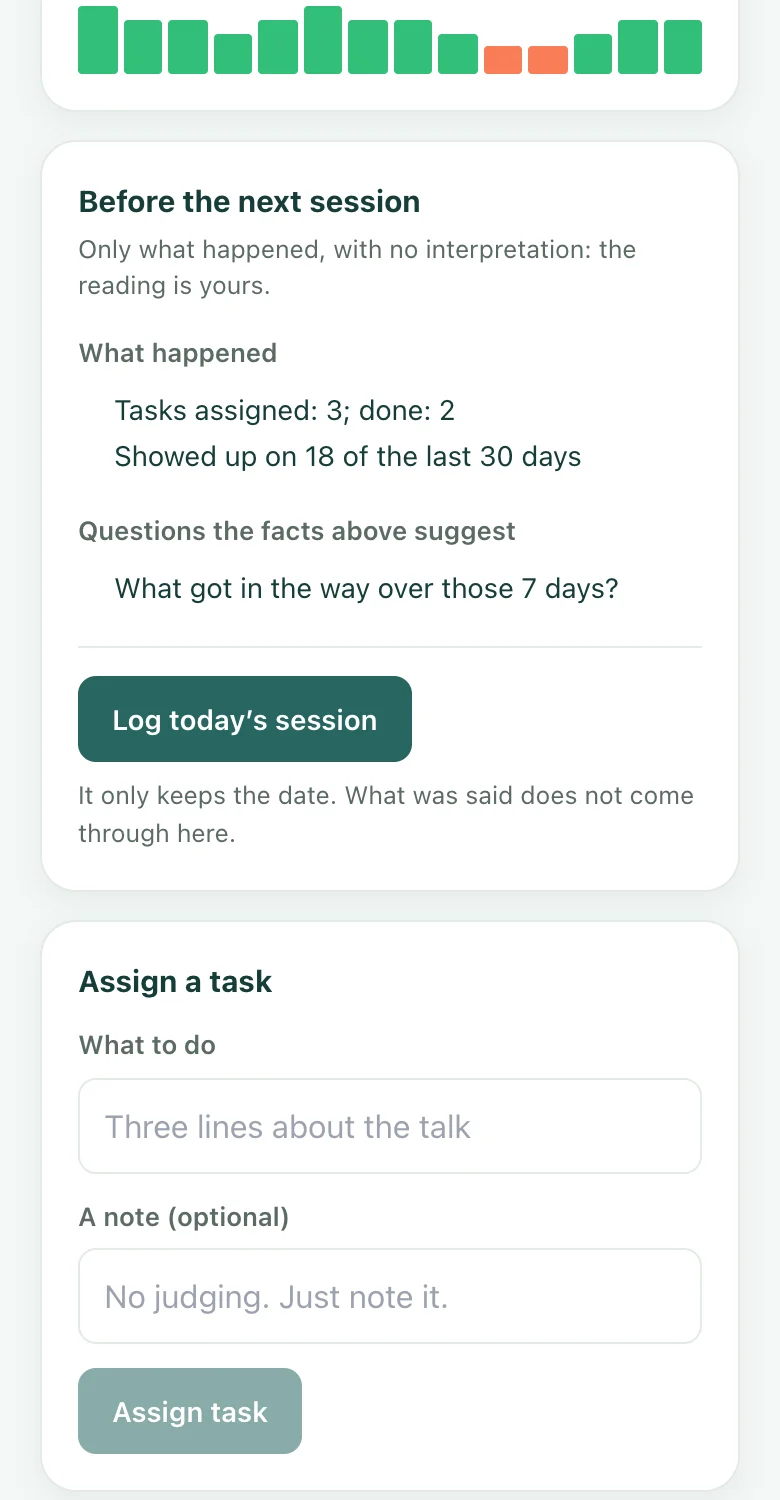
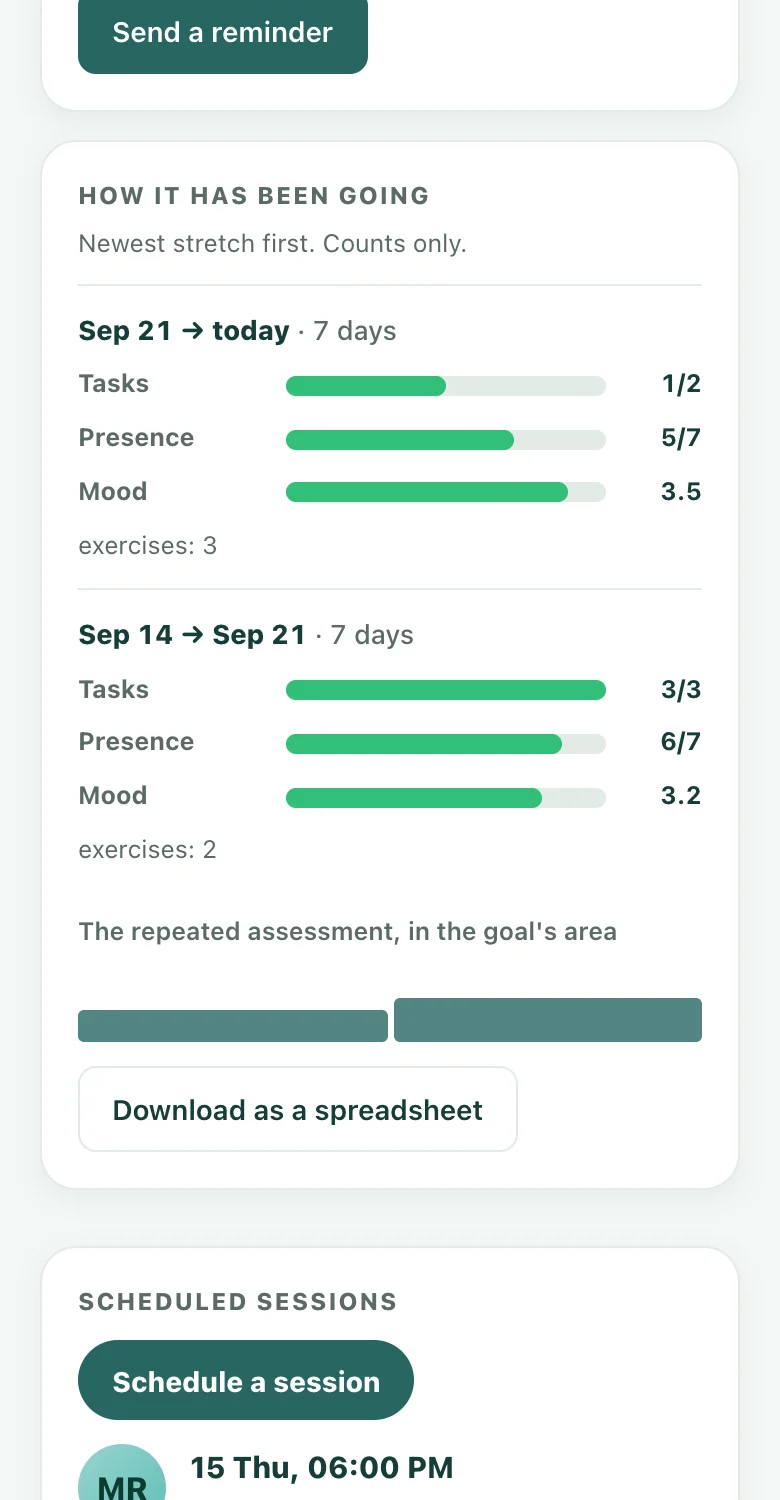
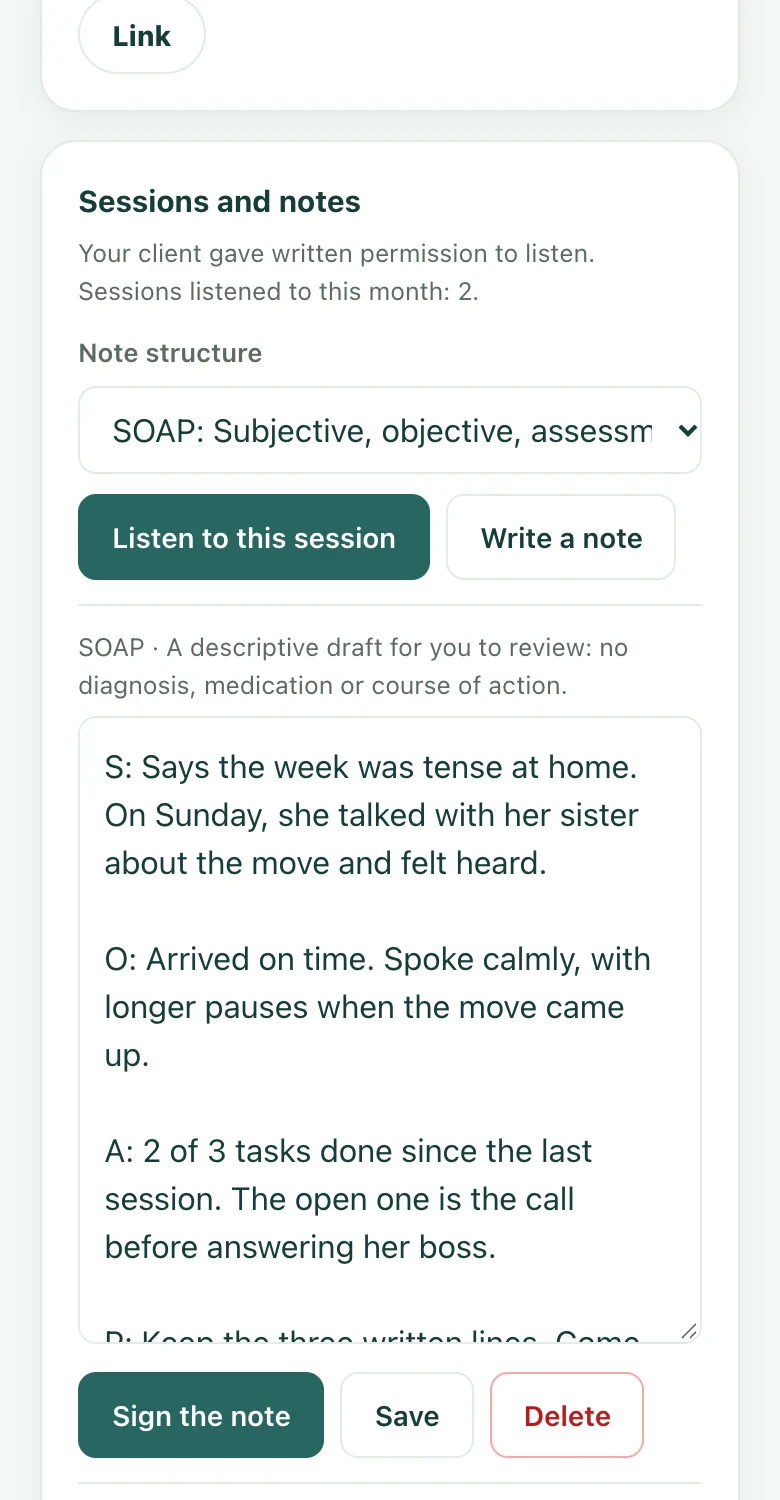
The real dashboard: the consent-based invite, the tasks, the session prep and the listening.
You see them for an hour a week. Their life has another hundred and sixty-seven.
What you agreed on in the session lives or dies in that gap, and the only way to know what happened is to ask at the start of the next one, spending its time. Whoever remembers well reports well; whoever does not reports what they remember. The gap stays invisible, and it is where the real work happens.
Homework between sessions is one of the few things in this field with many studies behind it.
hours a week your client goes on without you. That is where what you agreed lives or dies.
In the SAME therapy, people with homework between sessions ended better off than about 2 in 3 people without it. Not the difference between therapies.
Kazantzis, Whittington and Dattilio, 2010. 46 studies, 1,072 people; effect of 0.48.the relation between how much homework a person did and the result at the end of treatment. Doing it is not an admin detail.
Kazantzis and colleagues, 2016. 15 studies, 1,537 people; effect of 0.79.What this literature does NOT say: that Confidey improves clinical outcomes. It shows that homework between sessions matters and that completion relates to results. No study has measured this product, and we are not going to write that one has.
Three steps, and none of them is filling in records.
Open your space
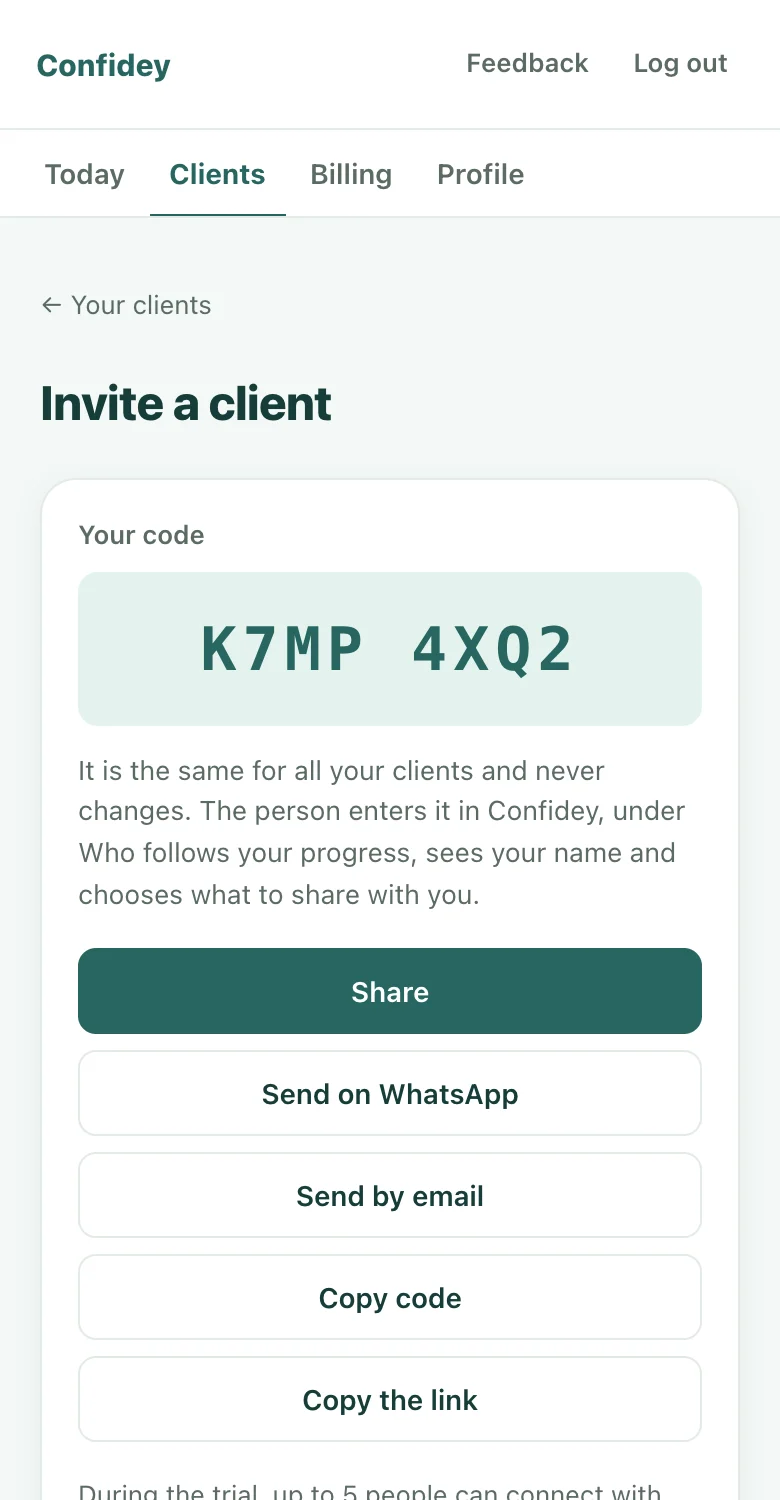
You create your professional account and get your code, one for all your clients. No practice setup, no calendar import, no migration of anything.
Invite the people you see
The person enters your code in Confidey, sees who you are and chooses what stays visible to you. Without their acceptance you see nothing, and that is on purpose.
Assign and follow
You pick from a catalogue of exercises and tasks, with deadlines. By the next session, what got done, what did not and where they got stuck is already organised, before you ask.
People looking for help find you on Confidey.
The free profile puts you in the search, and the request lands in your dashboard.
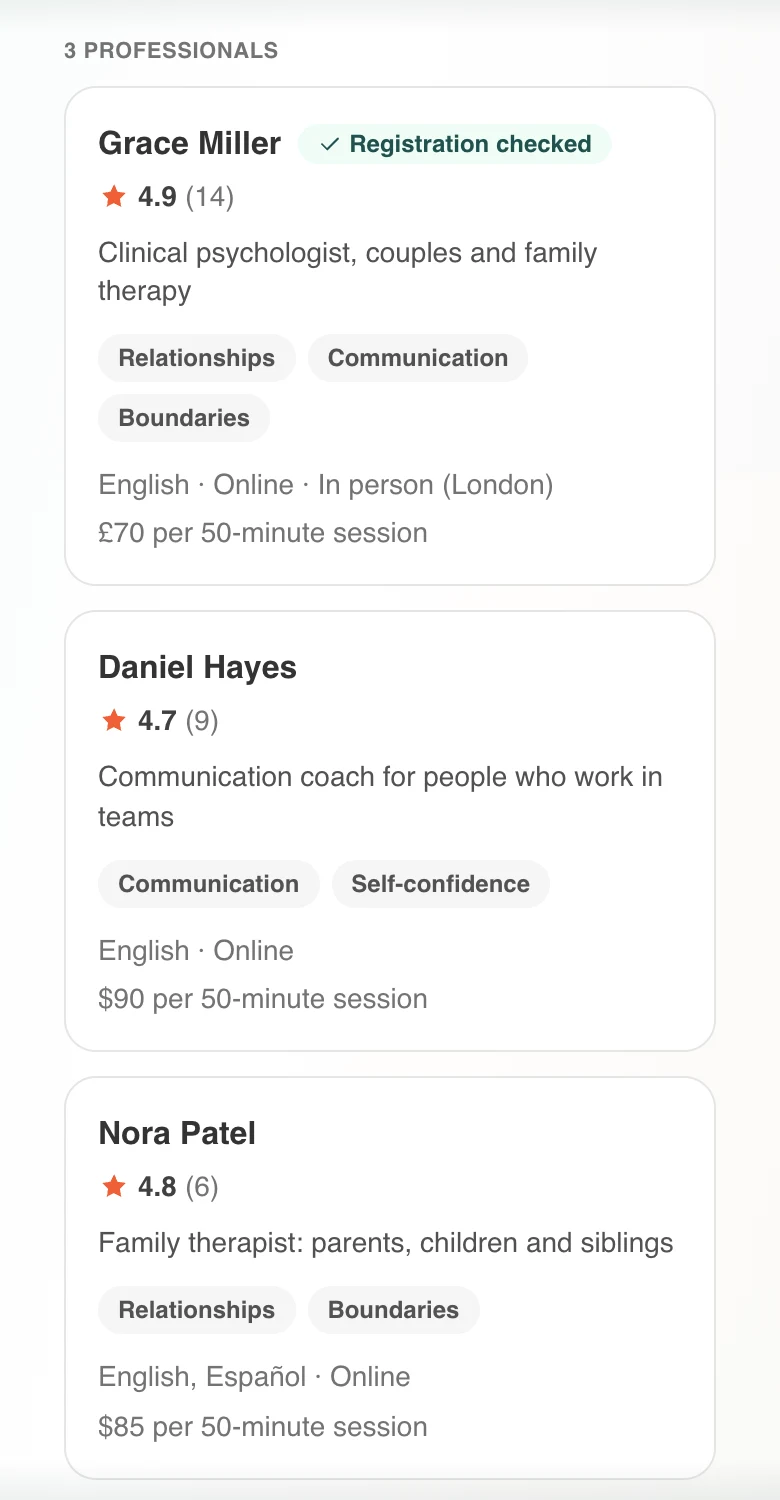
In the search, for free
In your language, your themes and the way you work, with no card. Paying does not change your place.
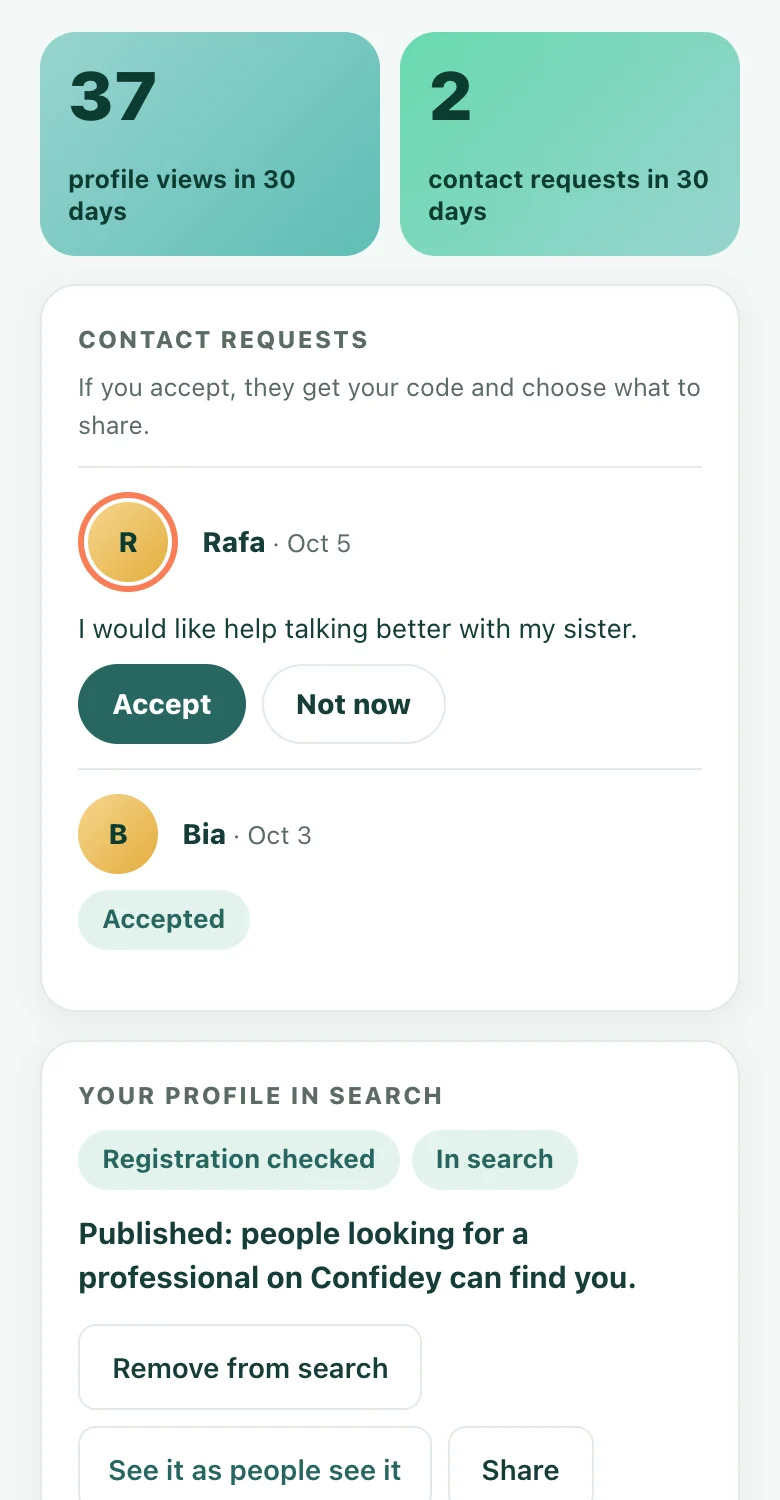
The request lands in your dashboard
With the name they choose to show and, if they want, a message. You accept right there.
The verified registration badge
Confidey checks your registration in the country’s public register. With the plan, your profile shows the badge, and people can filter by it.
The agreement, signed by both
From your field’s template, to check against your board’s rules. You both sign on Confidey, and only the two of you can open it.
Sessions with any client
By video, voice or in person, with the link by WhatsApp or email. Anyone not yet on Confidey joins through the link, for free.
What you see, and what you will never see.
The line between the two columns is not a setting: it is architecture. There is no permission that opens the second one, not for you and not for us.
- What you assigned and what was completed
- When it was done, and what is still open
- The goal the person chose
- A session preparation, organised from that
- What the person talks about with Confidey
- The calls they make, and what was said in them
- Their private notes
- Anything before they accept the link
Less time asking, more time working.
You assign, and follow along
Goals, exercises and tasks with deadlines. You see what got done, what did not, and where the person got stuck, without having to ask it all again at the start of the session.
Less admin work
Progress summaries and session preparation, organised for you to review. Everything goes through your review before it counts: the platform organises, you decide.
The person knows what you see
No invisible monitoring. What is shared with you is chosen and visible to them, and what is theirs stays theirs. Trust broken once does not come back.
Listening, only with two permissions
If the person gives written permission and you confirm it in the session, Confidey listens and drafts the note in the structure you use (SOAP, DAP or BIRP), which you review and sign. The audio is not kept, and the note is yours alone.
How it has been going, between sessions
Tasks done, exercises, days present and the assessment the person repeats, side by side from one session to the next. Counts only: the reading is yours.
What is yours, as a spreadsheet
Clients, sessions and each person’s progress as a spreadsheet that opens in Excel, Numbers and Google Sheets.
Note structures: SOAP is subjective, objective, assessment and plan; DAP is data, assessment and plan; BIRP is behaviour, intervention, response and plan.
For anyone who follows a person from one session to the next.
Psychologists and psychotherapists
Life and career coaches
Couple and family therapists
Mentors and advisors
Nutritionists and health professionals
Practices with more than one professional
One price per practitioner. The rest, from the dashboard.
- Show up in Confidey search
- Your public profile, with your code
- Contact requests from people looking for support
- Everything in Free, plus:
- Up to 5 clients followed between sessions
- 25 listened sessions a month, 5 per client, with the draft note
- Session prep, progress, exercises, agreement and spreadsheets
- Everything in Essential, plus:
- Up to 15 clients followed
- 75 listened sessions a month, 5 per client
- Everything in Complete, plus:
- Up to 30 clients followed, a practitioner’s full schedule
- 150 listened sessions a month, 5 per client
- Extra clientUS$ 7 a month, with their 5 listened sessions
- Extra listened sessionUS$ 1.50 each, on the next invoice
- Colleague in your practiceJoins from the dashboard, at the plan price, and sees only their own clients
14-day trial, with 5 clients and 10 listened sessions, your card at signup and the first charge only at the end. Prices in US$, € and £, with the same amount.
What people usually ask first.
Do you read my clients' conversations?
Does this replace the session?
What if the person does not want to share anything?
How do new people find me?
How much does it cost?
How do I start?
It is not a substitute for your professional judgement, it does not diagnose and it does not conduct treatment. It is software that supports your work, and clinical responsibility remains yours.
What helps in your practice
Practical articles for practitioners, every week.
 Your practice
Do Text Message Appointment Reminders Reduce No-Shows?
Sending a reminder before a session can save your practice's schedule. Learn how to use appointment reminders ethically, practically, and without invading client privacy.
 Your practice
How to Reduce Client No-Shows in Your Practice
Discover practical steps to reduce no-shows in your practice. Learn how to handle delays, keep your clients engaged, and organize your schedule while maintaining a relationship built on trust.
 Ethics and confidentiality
Informed Consent Form: What Your Practice Needs to Include
Learn how to structure a practical and welcoming informed consent form for your practice, ensuring professional protection while setting clear rules for care.
Start with 14 free days
You add your card at signup, and the first charge only comes at the end, with an email three days before. You invite up to five clients, assign tasks, follow how things went between sessions and listen to two of them. To just show up in search, the free profile needs no card.